US consumer confidence sinks in January to its weakest level since 2014
A sharp drop in the Conference Board’s January reading shows households growing more anxious about jobs, prices, tariffs and politics, even as the economy continues to expand. The expectations gauge remains at recession-warning levels, adding pressure on policymakers to show progress on affordability and hiring.
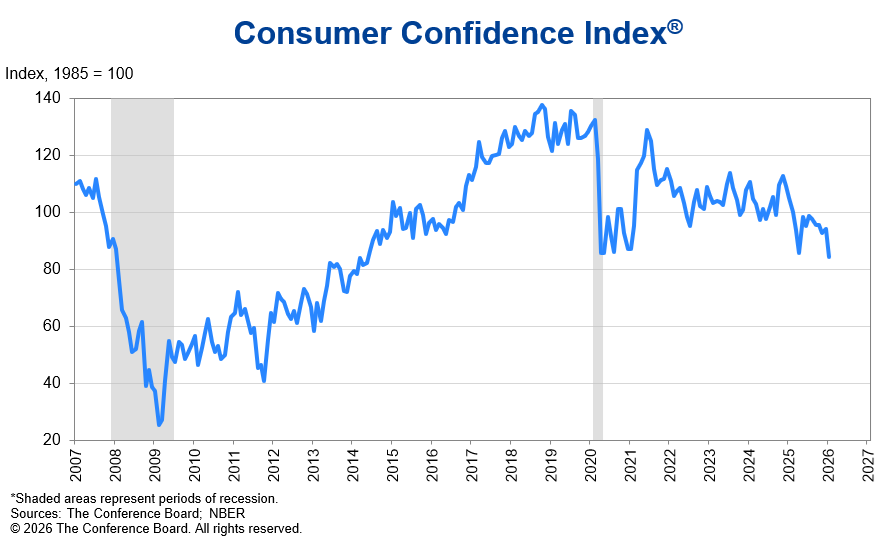
U.S. consumer confidence fell steeply in January, sliding to its lowest level since 2014, according to the Conference Board’s latest monthly survey. The headline confidence index dropped to 84.5, reflecting a broad deterioration in how households view both current conditions and the near-term outlook. The decline is notable not just for its speed, but because it pushes the measure below levels seen during the COVID-19 shock, underscoring how persistent worries have become about daily costs and economic stability. ([apnews.com](https://apnews.com/article/f36b997dc46ac9c3577d05db52166846?utm_source=openai))
The most closely watched component for forward risk—the expectations index, which tracks views on income, business conditions and the labor market—fell to 65.1. The Conference Board treats readings below 80 as a potential recession signal, and this marks the 12th straight month that expectations have remained under that threshold. In other words, even when spending and growth look resilient, consumers are increasingly bracing for tougher times ahead. ([apnews.com](https://apnews.com/article/f36b997dc46ac9c3577d05db52166846?utm_source=openai))
A key driver is mounting unease about jobs. The share of respondents who said jobs are plentiful dropped to 23.9%, while the share who said jobs are hard to get rose to 20.8%. Economists have described the environment as “low hire, low fire,” with companies staying cautious amid uncertainty tied to interest rates and tariff policy. The survey’s labor-market deterioration lines up with the broader tone of households reporting less confidence in wage growth and mobility. ([apnews.com](https://apnews.com/article/f36b997dc46ac9c3577d05db52166846))
Households also flagged an expanding list of stressors—concerns about inflation, tariffs, politics, health insurance and international conflicts. Those worries have become intertwined: higher prices squeeze budgets; policy uncertainty can delay hiring and investment; and global events add to the sense that the outlook could change quickly. The message is that the economy’s “macro” performance is not translating into psychological comfort for many consumers. ([apnews.com](https://apnews.com/article/f36b997dc46ac9c3577d05db52166846?utm_source=openai))
The confidence slump lands after a period of weak job creation. The government recently reported that employers added 50,000 jobs in December, and 2025’s total job growth was far lower than in 2024. Even with an unemployment rate around the mid-4% range, the pace of hiring matters for sentiment: when people think opportunities are narrowing, they often become more conservative about major purchases, travel and discretionary spending. That behavioral shift can, in turn, slow growth. ([apnews.com](https://apnews.com/article/f36b997dc46ac9c3577d05db52166846))
For policymakers and business leaders, the January reading is a warning light. Confidence does not always predict immediate downturns, but it can shape consumer behavior and amplify other headwinds. The challenge now is whether slower inflation and steadier hiring can restore optimism, or whether anxiety about costs and policy will keep expectations depressed through early 2026.